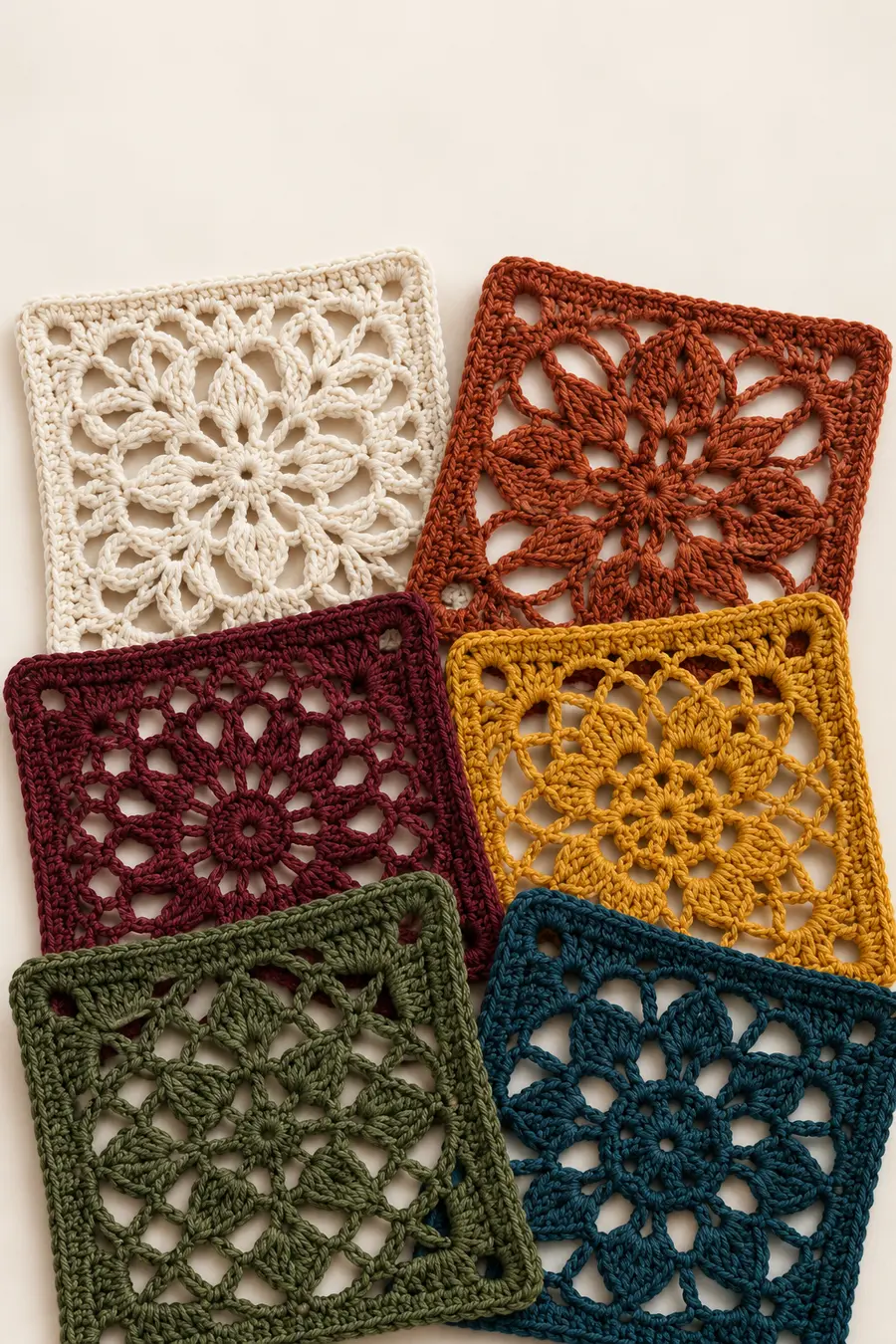
Lace granny squares are not limited to vintage blankets. A consistent border, careful blocking and a controlled color story can turn an ornate motif into a modern bag, vest, wall piece or lightweight throw.
The ideas below describe visual directions and project pairings. For exact increases, chain spaces and stitch counts, use a complete tested pattern and make a swatch first.
Six motif directions
- Eight-petal radial lace. A strong flower center and generous chain spaces create a clear focal point.
- Leaf-window square. Long leaf shapes feel graphic when surrounded by a plain, substantial border.
- Fine spiderweb geometry. Use one color so the negative space, rather than color changes, defines the motif.
- Raised floral center. Keep the three-dimensional petals shallow if squares will be used in a garment or cushion.
- Sunburst openwork. Alternate dense spokes with clean gaps and finish with a squared-off final round.
- Minimal corner lace. Concentrate detail in the corners and leave the center calm for an understated look.
Three palettes that feel current
Autumn jewel
Deep wine, rust, mustard, olive and dark teal. Keep the same cream joining color across the project to calm the variety.
Soft botanical
Ivory, oatmeal, muted blush, cocoa and sage. Repeat only one flower-center color to build rhythm without looking overly matched.
High-contrast neutral
Black, warm white and camel. Assign one color to the motif and a contrasting color to the outer rounds for a strong graphic grid.
Six projects that suit lace squares
- Lightweight lap throw. Choose a motif with stable edges and join with narrow, consistent seams.
- Structured market bag. Line the finished bag so openwork does not stretch under weight.
- Boxy summer vest. Swatch, block and measure before deciding how many squares each panel needs.
- Framed textile art. Mount a single detailed square over a contrasting archival-quality backing.
- Statement cushion front. Put the lace panel over a solid fabric cover so the stitchwork remains visible.
- Narrow table runner. Use repeated squares with a quiet border and a washable plant-based fiber.
Block before you judge
Openwork often looks uneven directly from the hook. Make one complete square, wet-block it according to the yarn care label, and pin it to the intended dimensions. Let it dry fully before evaluating the drape, holes and corner angles. This first blocked square should become the size reference for every motif that follows.
For joining, choose a method that supports the final use. A flat seam keeps garments smooth. A visible slip-stitch join adds a graphic line to blankets and cushions. Whatever you choose, test the seam across two blocked samples before committing to an entire project.
Note: This article is an inspiration and planning guide. It does not replace a tested pattern, gauge swatch or fiber-care instructions.